 The Uncanny Post
Interpretation · Dream reading
Spider in Dream Meaning: Dreaming of Spiders Explained
A dream about spiders is a scene to examine, not a message with one guaranteed translation. A spider building a web outside your window is different from one crawling across your hand, and both differ from a bite you never actually felt. Before deciding what spiders mean, record what happened and what changed because of it. This guide offers a practical way to interpret the details, compare ordinary waking sources with personal associations, and reject explanations that do not fit. You will leave with a short record, two testable possibilities, and permission to remain uncertain.
By The Uncanny Post · 10 min read · Published
Share this article
Open a share composer
Copy a link to post yourself
These services do not offer a dependable web share window here. Choose one to copy the link and open its site, then paste it where the service allows links.
What should you record before interpreting dreams about spiders?
Begin with the spider in your dream as you remember it: where it was, what it did, how close it came, and what you did next. Describe the sequence without translating it. Write 'a spider crossed the table while I moved my cup,' not 'danger invaded my safe space.' The first sentence preserves observations; the second adds a theory. If the setting or ending is unclear, leave it unclear. A useful dream record does not require a complete story.
Try our original SILK check: Scene, Interaction, Link, and Knockout detail. Scene records the place, spider, and web. Interaction records distance, movement, contact, and response. Link names a specific waking experience or association, if one comes to mind. The knockout detail is something that weakens your preferred interpretation. A calm response, open exit, or familiar pet can challenge a fear-based explanation. SILK is an editorial note-taking aid, not a validated psychological test.
Keep the dream state and your later reaction separate. You may have watched calmly while asleep but felt disgust when remembering it. That difference matters. Record both emotional states with their timing instead of rewriting the experience around how you feel now.
Do spiders in dreams signify fear, creativity, or something else?
Start with what you personally associate with spiders. A dreamer who keeps one as a pet has a different starting point from someone who avoids photographs of them. Fear, interest, admiration, irritation, and indifference are possible responses, not meanings built into the animal. If you associate spiders with patient work, ask whether the dream actually showed patient work. If you associate them with danger, ask whether the scene contained an approach, threat, or injury.
A proposed symbol should explain the details rather than replace them. 'This may symbolize feeling trapped' needs an obstacle, failed escape, restraint, or another relevant event, plus a recognizable waking comparison. An empty room with an open door and a distant spider provides weaker support. Similarly, watching construction may invite a creative association, but merely spotting an animal does not demonstrate a creative spirit or an ability to create.
Research offers a limited reason to look at waking life. In Wamsley's laboratory study, 48 college students identified possible waking sources for 469 reports. Many accounts were linked to past experiences, anticipated events, or combinations of sources.[1] That finding supports asking about source material. It does not establish what a spider must signify, validate a universal symbol dictionary, or predict what will happen.
Source for this section: reference 1
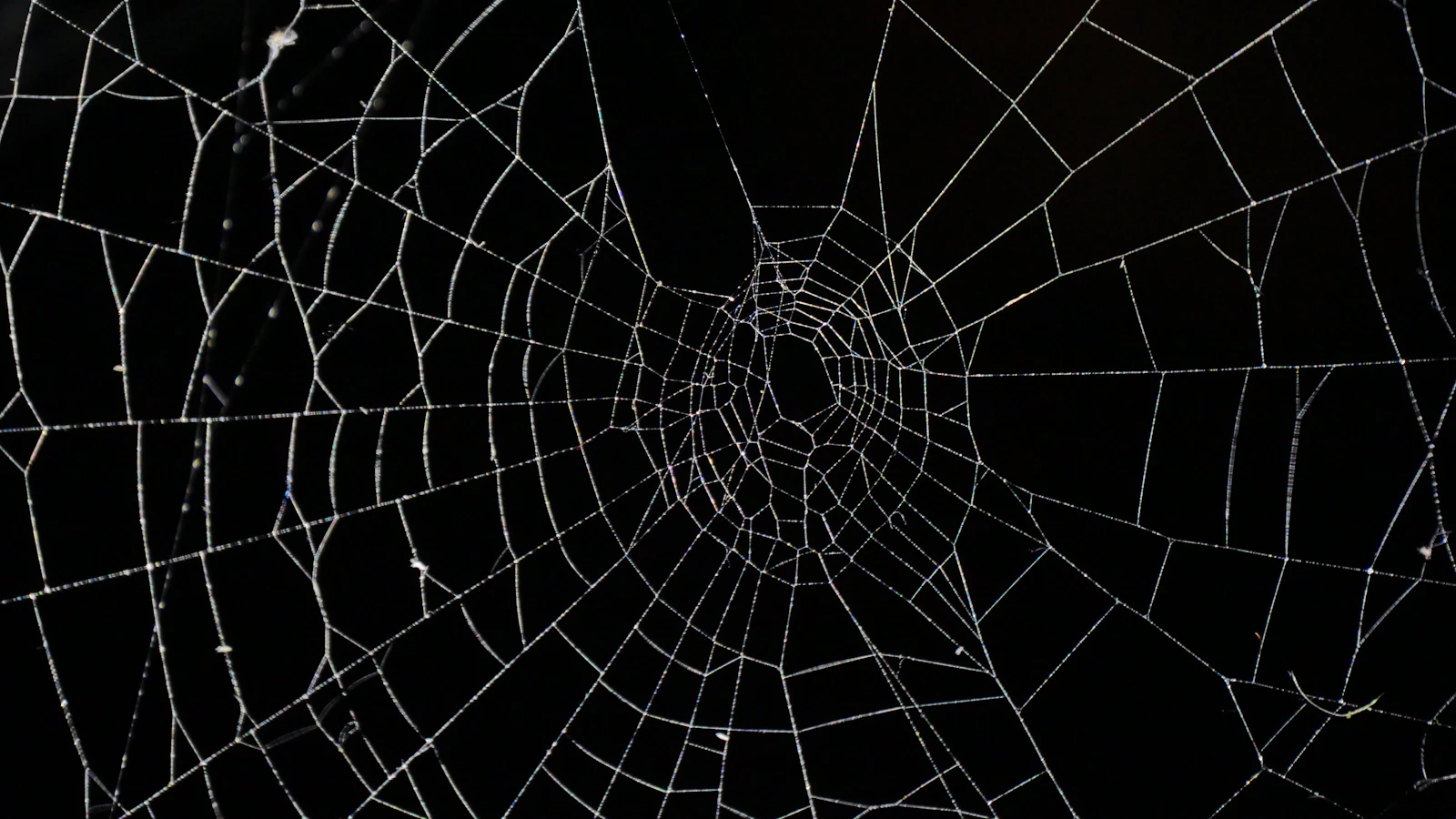
What changes when you see a spider weaving a web?
Separate the builder, the finished structure, and your contact with it. A spider weaving a web while you watch presents a different sequence from walking into sticky strands or clearing an abandoned corner. Record whether the web was complete, damaged, occupied, decorative, or blocking your path. Did you admire it, avoid it, repair it, destroy it, or simply continue? If you cannot remember, do not borrow details from a familiar interpretation.
A spider web can suggest an association without proving it. Creating a web may remind you of assembling a project when that comparison is genuinely yours. Becoming trapped or entangled may invite a comparison with obligations when the dream includes restricted movement. Neither association follows automatically from the animal's ability to weave. Spiderwebs outside a window could also recall something you recently saw while cleaning or gardening.
Be particularly careful with the phrase 'web of lies.' A web does not establish deceit by someone in your life. Before making an accusation, you would need real-world evidence unrelated to the dream. If an entrapment reading ignores the fact that you stepped around the strands easily, lower your confidence. The best question is what the web changed in the scene, not which symbolic label sounds most dramatic.
How should you read a dream about a spider crawling?
Movement gives you a sequence to compare. Was the spider coming toward you, passing you, moving away, or staying on one object? A dream about a spider crawling on your sleeve differs from watching one cross the ceiling. Distance, direction, and contact can make an interpretation more specific. Do not describe an approach as an attack unless the remembered action supports that description. Seeing a spider nearby is not the same as being pursued.
If you dream of spiders crawling across your body, record the exact sensation and your response. Did you brush them away, freeze, inspect them, ask for help, or remain untroubled? Also note any ordinary sensation noticed on waking, such as fabric against skin, without assuming it caused the dream. You cannot reconstruct the cause from timing alone. Spiders could be part of an unfamiliar scene, a recent visual memory, or a personal association; the report may not distinguish these possibilities.
Spiders hanging above you add another question: did anything fall or was falling only expected? Anticipated contact and actual contact are different events. If the main action was waiting for something that never happened, keep that uncertainty in your notes. Avoid converting every movement into evidence of anxiety or stress.
What does a spider bite change in the dream?
A spider bite adds contact and a possible consequence, but it still has no fixed translation. Record whether you saw the bite, felt pain, noticed a mark, or only believed you had been bitten. Those are different forms of evidence within the dream. Then write what followed: seeking help, checking the skin, continuing normally, or waking before anything else happened. Do not add venom, illness, or betrayal because an interpretation list mentions them.
If the spider attacks, describe the action rather than assigning an intention. A leap, chase, bite, and defensive movement are not interchangeable. The same care applies to a remembered tarantula attack: record why you identified the animal that way, and distinguish recognition in the scene from a species label added afterward. A dream image cannot establish a real exposure or medical condition.
Keep waking symptoms separate from symbolic interpretation. Any actual injury or persistent physical concern deserves attention on its own facts, not because the dream predicted it. When no real symptom exists, there is no need to search your body for proof of the story. The useful question is how the contact altered your choices within the account.
Do a giant spider, a small spider, or many spiders mean different things?
Scale changes the scene without supplying a universal meaning. A giant spider blocking a doorway may prevent an action; a small spider on a distant shelf may change nothing. Ask what you could and could not do because of its size. Do not assume that a large animal represents a large real-life problem. If it was enormous but friendly, a threat interpretation has an important counterexample to explain.
With multiple spiders in your dream, notice the arrangement. Were they scattered, clustered around one object, appearing one after another, or simply present in the background? A scene of searching for a clear path differs from one of calmly observing many animals. Feeling overwhelmed is relevant only if that feeling or a comparable difficulty actually appears. Count approximately when exact numbers are unavailable; invented precision will not improve the reading.
Details such as spider eggs or the color of the spider may help identify a remembered source. A black widow spider might connect to a recognizable picture, story, or encounter, but the label does not prove a relationship warning. Compare what you remember seeing with what you concluded. Colors and species should narrow the description, not become shortcuts to fate, personality, or another person's intentions.
What if you dream of killing a spider or protecting one?
Killing a spider changes the action, but the dream does not determine whether that action represents courage, cruelty, relief, or something else. Ask what prompted it and how you reacted afterward. Was it an automatic gesture, a response to contact, an attempt to help someone, or a choice you regretted? Dreaming of killing an animal is not evidence that you want to harm one while awake. Keep imagined behavior separate from your values and actual conduct.
Protecting or moving the spider offers different details. You might have used a cup, opened a window, asked another person to leave it alone, or watched it leave. These actions could invite a personal comparison with care or boundary-setting if a specific situation fits. They could also reproduce an ordinary household routine. The spider in the dream is not required to stand for someone or something else.
Compare the result with the intended result. Did moving it solve the problem, or did another appear? Was the web hard to remove, or did it lift away immediately? An interpretation about an unresolved difficulty fits poorly when the remembered problem ended easily and no waking comparison comes to mind. Let the ending challenge the explanation.
Can seeing spiders have a spiritual or subconscious meaning?
You may choose to reflect through a spiritual tradition or personal philosophy, but identify that lens explicitly. Folklore is not the same kind of evidence as a laboratory study. An image that you choose to symbolize patience, protection, or transformation can be meaningful to you without becoming a universal prediction. A responsible reading leaves room for another dreamer to make a different association or none at all.
Terms such as feminine energy and subconscious mind can sound explanatory while leaving the actual scene untouched. Ask what the words mean in your own account and which details support the connection. Do not infer a person's gender, motives, sexuality, or character from an animal. Likewise, calling a spider the dark side of your personality is a strong judgment that the image alone cannot justify. You do not have to adopt a frightening label to take a dream seriously.
Dreaming about spiders could become an occasion for reflection, but reflection is not an instruction to act. Before deciding it is time to confront another person, separate dream associations from observable events in the relationship. Discuss a real concern because of the real concern. The meaning of this dream may remain uncertain even when the conversation you need is clear.
How can you test two spider dream interpretations?
Consider this invented example: 'A spider built a web across the kitchen window. I watched it work, moved a plant so it had more room, and went back to breakfast.' SILK records a familiar room, observation rather than pursuit, a helping action, and no recalled fear. A creative-work association might fit if the dreamer recognizes a specific project. A danger reading fits less well because there is no threat or escape attempt. A recent gardening memory remains another possibility.
Now change one detail: 'The web crossed the only exit, and I kept catching my sleeve while trying to leave.' Restricted movement gives a feeling-trapped interpretation more scene support. It still needs a waking comparison and does not prove one. Spiders could appear in both accounts while the useful questions differ. This is why dream interpretation should preserve the sequence instead of treating the animal's presence as a complete explanation.
For your own report, write two possibilities and one ordinary-source alternative. Under each, list supporting details and a knockout detail. Dreams could combine several sources rather than express a single theme. Dreams could also leave too little remembered material for a fair comparison. A conclusion such as 'possible connection, insufficient evidence' is a valid outcome, not a failed interpretation.
What should you do after a recurring spider dream?
Keep separate dated entries before looking for repetition. Track setting, distance, web, contact, response, and ending. Add possible waking sources in a different field. If you have three reports but remember only one clearly, do not treat all three as identical evidence. Spiders could recur while their role changes from threat to background detail. Both positive and negative experiences belong in the record, along with neutral ones.
It is not safe to assume all spider dreams are negative. If you fear spiders while awake, record that as context without diagnosing arachnophobia from a dream. If you already have a diagnosis, the dream is still not a measure of its severity. Unresolved feelings are possible topics for reflection, but repetition alone does not establish them. Distressing experiences that repeatedly disrupt your sleep can be discussed with a qualified professional without first choosing a symbolic explanation.
For a practical next step, use our published guide to using a dream dictionary, then compare recurring accounts with the same fields. Keep private details and other people's identities out of anything you share unnecessarily. The aim is not to decode every aspect of your life. It is to preserve the context of the dream, test a few possibilities fairly, and stop before uncertainty becomes certainty.
Sources and scope
References support the statements identified above. The writing exercises and worked examples are editorial suggestions, not findings from these sources.
1. Erin J. Wamsley. “Constructive Episodic Simulation in Dreams.” PLOS ONE 17, no. 3 (2022): e0264574. doi:10.1371/journal.pone.0264574. Read source
48 college students and 469 laboratory reports; participants identified possible waking sources retrospectively. This does not validate particular symbols or the editorial exercises.